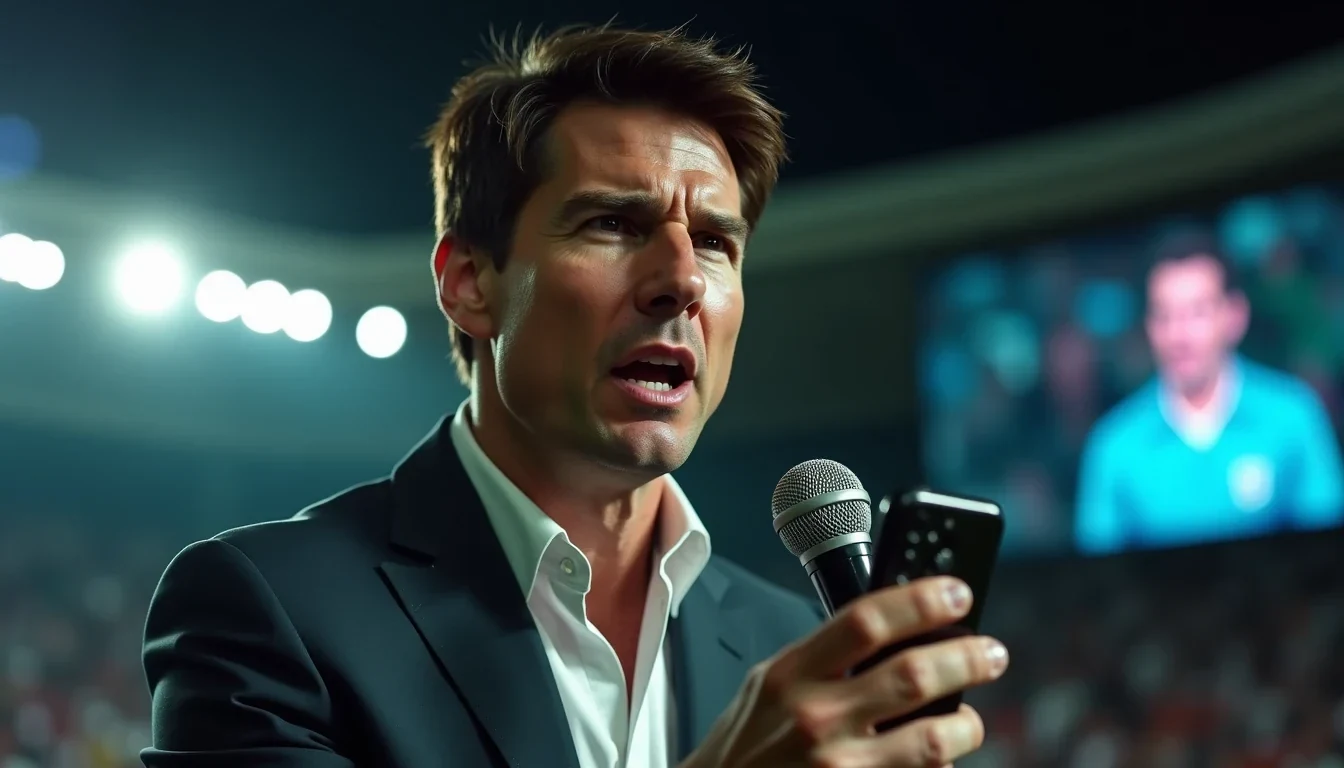
Tom Cruise appeared at the World Cup final as if the room had been built for him, then got reminded, very publicly, that football does not care about his brand. He arrived with the serious, granite-jawed energy that usually sells out a multiplex, delivered a speech about soccer bringing people together, and still managed to look like he was auditioning for the main character slot.
The internet reacted as it always does when a famous man arrives too convinced of his own importance. It blinked, laughed, and moved the spotlight back to the match.
The speech landed like a trailer
Cruise’s message was meant to be grand. He spoke about the game pulling the world into one place, the usual global-unity stuff, but delivered with the intense face and clipped gravity that fans know from his action roles. He did not sound like a guest at a sporting ceremony. He sounded like he was about to climb a building, pilot a helicopter, or save the planet before half-time.
That tone was the problem. A World Cup final already has enough drama without a Hollywood star adding a layer of self-importance. The ceremony had other performers, the teams were preparing, and Spain and Argentina were about to play the kind of match people had been waiting all night to see. Cruise still leaned in as if the whole evening had been arranged for his monologue.
Viewers noticed immediately. The online reaction was less “inspiring” and more “why is he talking like this?” People questioned his presence, then criticized the delivery itself. The speech was treated like an over-rehearsed scene that had wandered into the wrong program.
Roy Keane said what everyone was thinking
Former footballer Roy Keane did not need a long breakdown. He looked baffled on air and cut through the moment with one dry line: “He isn’t going to sing, is he?”
That joke did a lot of work. It captured the weirdness of the appearance, the mismatch between the setting and the performance, and the slight embarrassment of watching someone swing too hard for a moment that was never theirs to own. If you are going to interrupt a football final, you need either charm or brevity. Cruise brought neither.
The irritation was not only about tone. Plenty of viewers were angry that the ceremony felt stretched out for extra entertainment when they were there for one reason: the final itself. People did not tune in for a motivational speech from a man who makes running across a rooftop look contractual. They wanted the match.
The game swallowed the glamour
By the time the evening settled, the football had done what football usually does to celebrity cameos. It made them look tiny.
Spain beat Argentina 1-0 after extra time. The result on the pitch became the real story, and everything else faded into background noise where it belonged. That is the brutal charm of sport. A global star can stride in with a carefully polished message and still get outshone by a single goal, one extra-time twist, one night of people caring more about the scoreboard than the speech.
Cruise is used to commanding a scene. He has built a career on looking like the most committed person in the room. But a World Cup final is not a film set. The audience is not there to be impressed by your intensity. They are there to watch something happen that cannot be repeated.
The fallout hit his ego harder than the clip
According to In Touch, an unnamed source said Cruise thought this appearance would be one of the big moments of the night. The same source claimed the backlash knocked his confidence and left him annoyed that the reaction was nowhere near as warm as he expected.
That part has not been confirmed by Cruise or anyone speaking for him, so treat it as a reported claim, not a fact carved into stone. Still, it fits the shape of the embarrassment. This was not a tiny misfire tucked away on page six. It was a public swing and a miss, in front of a huge audience, at an event where he apparently expected to be celebrated.
This makes the whole episode entertaining in a slightly brutal way. A man who spends his career carefully controlling the frame stepped into a setting he could not control. The match, the crowd, the online pile-on, even Keane’s joke, all reminded him that fame is not the same thing as ownership.
Why people loved the backlash
The reaction traveled so fast for a reason. It was not cruelty for its own sake; it was recognition. Everyone knows the person who turns a simple thing into a performance: the friend who makes the toast longer than necessary, the bloke who thinks his entrance deserves music, applause, and lighting cues. Cruise just did that on a global stage.
The World Cup final did not need his gravitas. It had Spain, Argentina, a packed ceremony, and enough tension already baked in. He brought blockbuster seriousness to a night that was always going to belong to the game. That mismatch is why people laughed.
The whole episode lands as a neat little reminder that celebrity is very persuasive until it isn’t. Some moments are too big for any one star to hijack, no matter how famous they are or how carefully they hit their lines. Cruise showed up ready to be memorable. Football looked at him, carried on, and let the match have the last word.